
Nuclear fusion is often described as the holy grail of clean energy: a process that could one day provide abundant power without carbon emissions or long-lived radioactive waste. It has so much promise, but it’s difficult. This article on fusion explains why. But turning fusion into a practical energy source depends on solving a set of extremely difficult physics problems. One of the most important is how to keep plasma — a super-hot, electrically charged gas — dense, stable, and confined long enough to produce useful energy.
The post China is one step closer to making artificial sun appeared first on Green Prophet.
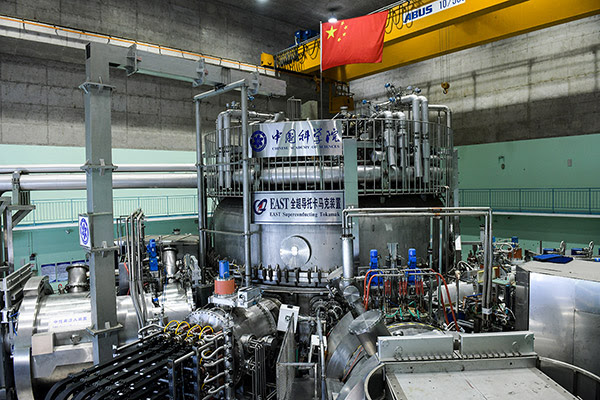
Researchers hope that nuclear fusion in reactors like this one will one day produce clean, virtually limitless energy by replicating the processes that power the Sun.
Why China’s “Artificial Sun” Density Breakthrough Matters
Nuclear fusion is often described as the holy grail of clean energy: a process that could one day provide abundant power without carbon emissions or long-lived radioactive waste. It has so much promise, but it’s difficult. This article on fusion explains why. But turning fusion into a practical energy source depends on solving a set of extremely difficult physics problems. One of the most important is how to keep plasma — a super-hot, electrically charged gas — dense, stable, and confined long enough to produce useful energy.
In January 2026, researchers working on China’s Experimental Advanced Superconducting Tokamak (EAST), often called the “artificial sun,” reported a breakthrough in this challenge in Science Advances. Their experiment showed that plasma could operate at densities 30% to 65% higher than EAST normally achieves — beyond a long-standing boundary known as the Greenwald density limit — while remaining stable. They reported their breakthrough in the journal Science Advances. Their plasma burned 5 times hotter than the sun.
China fusion burns 5 times hotter than the sun
Why does density matter? Fusion reactions become more efficient when more particles are packed into the plasma. High density is essential to meeting the Lawson criterion, the basic condition for producing more energy than the reactor consumes. For decades, however, increasing density has usually caused plasma to become unstable and suddenly collapse, ending the experiment.
The EAST team overcame this by using a carefully designed start-up method that combines traditional electrical heating with electron cyclotron resonance heating (ECRH), a microwave technique that warms electrons directly. They also adjusted the amount of neutral gas in the chamber before ignition. Together, these changes allowed the plasma to enter what scientists call a “density-free regime,” predicted by a recent plasma-wall self-organization theory.
Burns 5 times hotter than the sun
In simple terms, this means the plasma and the reactor walls interacted in a way that reduced harmful impurity radiation — one of the main causes of instability. With fewer impurities cooling the plasma, the system could tolerate much higher densities.
The experiment achieved line-averaged electron densities up to 1.65 times the standard operating range of EAST. Importantly, the results matched theoretical predictions, strengthening confidence in the underlying physics model.
Researchers working on China’s Experimental Advanced Superconducting Tokamak (EAST)
This does not mean fusion power plants are now close to commercial operation. EAST did not produce net energy from fusion, and many engineering and materials challenges remain. However, the study demonstrates that a fundamental limitation in tokamak operation may be more flexible than once believed.
For the public, the importance is simple: every improvement in plasma stability and density brings fusion researchers closer to designing reactors that could one day operate continuously, efficiently, and safely. This work shows that the “rules” of fusion confinement are still being rewritten — and that progress is coming from careful physics, not science fiction.
If you are a science geek, you can read all about it here.
The post China is one step closer to making artificial sun appeared first on Green Prophet.